
What's New?
welcome to
EuroHPC JU Center of Excellence
MultiXscale is a European High Performance Computing Joint Undertaking (EuroHPC JU) Center of Excellence in exascale-oriented application co-design and delivery for multiscale simulations. It is a collaborative 4-year project between members of the CECAM network and the EESSI community that will allow domain scientists to take advantage of the computational resources offered by EuroHPC JU.

Software installations optimized for specific CPU microarchitectures. Automatic selection of best suited software installations for more efficient use of HPC systems.

Relieving scientists from having to reinstall software. Ready-to-use software releases. Easy access to dependencies for continuous integration and testing.
Shared software stack is not bound to a particular platform. Easy migration between systems without sacrificing performance. Easy to replicate results with the same software on any system.
High level consultancy for domain scientists
MultiXscale offers its users: Initial consultancy to help in addressing user-specific problems, advice on choosing the most appropriate code and parameters to perform simulations.
Services to industry
MultiXscale offers its users: Training on how to use EESSI and the available software, initial consultancy to help in addressing industry-specific problems, advice on choosing the most appropriate code and parameters to perform simulations.
Accessing EuroHPC resources
MultiXscale offers its users: Advice on accessing EuroHPC resources, advice on appropriate resources for their use case, tips for preparing proposal.
Simulations on premise and in the cloud
MultiXscale offers its users: Advice on how to support MultiXscale software packages and EESSI, both locally and in cloud solutions, guidance on additional technologies that may be useful for the use case.
Press releases
Press releases
Find out all training events offered by MultiXscale.
Join us for EESSI Happy Hour, an informal, weekly online session to explore and discuss key EESSI topics and updates with the community. Each series will focus on a specific main topic over several sessions, giving participants the opportunity to ask questions, get hands-on guidance, and share experiences.
Webinar series give a comprehensive overview of EESSI.
Recordings of the CECAM Flagship Workshop titled "Modeling & simulation of fluid-structure interactions across scales".
Code couplings
Deliverables
Publications
- Towards nonlinear thermohydrodynamic simulations via the Onsager-regularized lattice-Boltzmann method
- Investigating the effect of particle size distribution and complex exchange dynamics on NMR spectra of ions diffusing in disordered porous carbons through a mesoscopic model
- Effect of implementations of the N-body problem on the performance and portability across GPU vendors
- Portable test run of ESPResSo on EuroHPC systems via EESSI
Code couplings
Deliverables
Publications
- Towards nonlinear thermohydrodynamic simulations via the Onsager-regularized lattice-Boltzmann method
- Investigating the effect of particle size distribution and complex exchange dynamics on NMR spectra of ions diffusing in disordered porous carbons through a mesoscopic model
- Effect of implementations of the N-body problem on the performance and portability across GPU vendors
CECAM is a scientific network started in 1969 to promote fundamental research on advanced computational methods.
It provides the scientific backbone to support the project with three showcase areas for multiscale modeling:
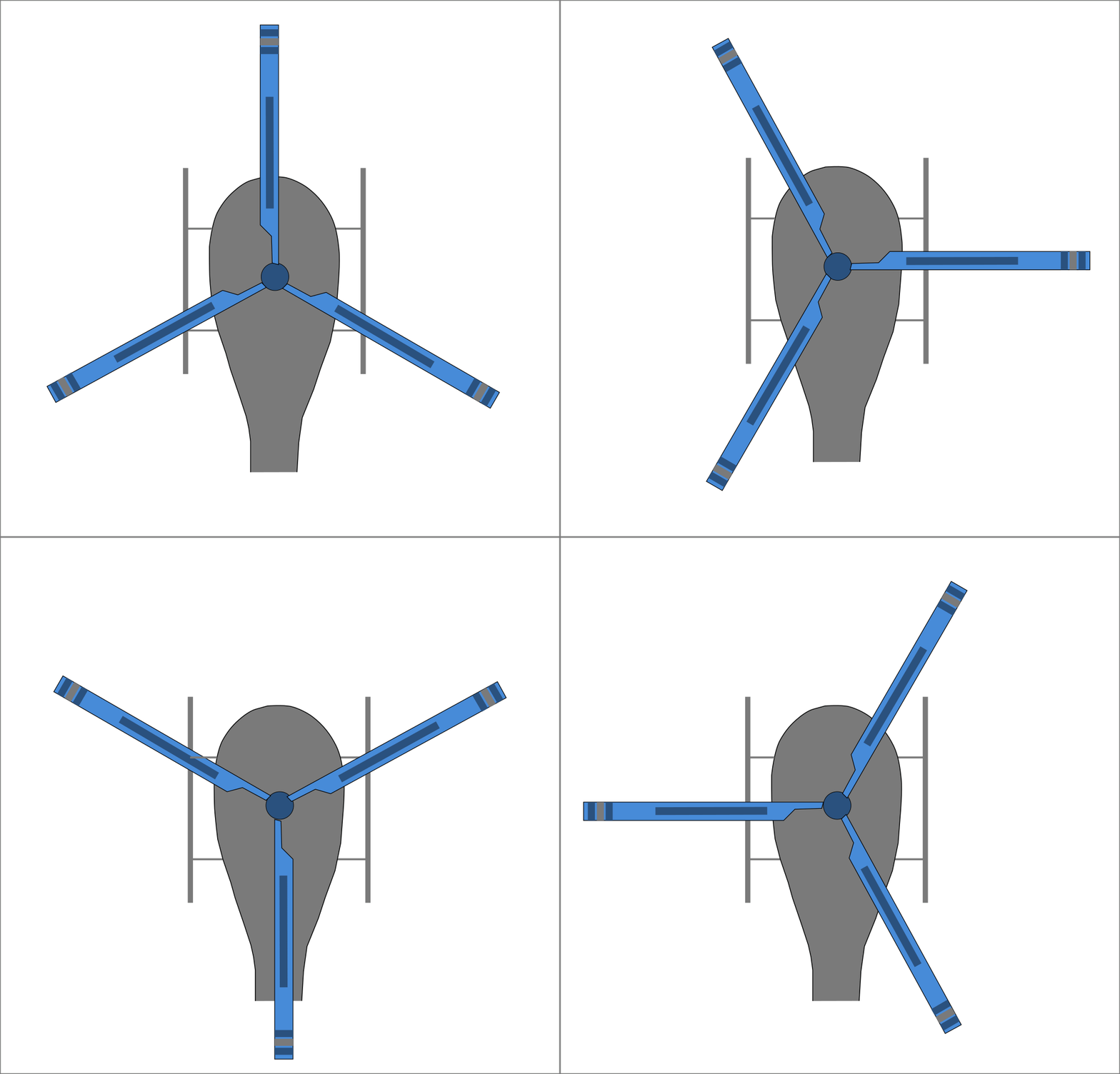
- Advanced parallel aerodynamic code for rotor aeroelastic analyses.
- High-power battery applications: Towards enhanced supercapacitor.
- Biomedical applications of ultrasound: Improving diagnostics and guiding drug delivery.
EESSI is a tool developed by a networks of HPC community partners whose goal is to build a common stack of scientific software installations for HPC systems.
It provides the technical backbone to the project, including CI/CD capabilities and hardware support across EuroHPC resources. EESSI aims to reduce the technical burden on developers and end-users of scientific applications.