Author name: susana

Video available online: “Streaming Optimised Scientific Software: an Introduction to CernVM-FS”

The tutorial given by Valentin Völkl (CERN) on 4th June 2025, in the framework of the event HPC Knowledge Portal annual meeting – HPCKP25 Barcelona, is already available on the website through this link. HPC Knowledge Portal annual meeting is a key global event for High-Performance Computing able to attract relevant professionals and main developers of leading software projects widely used by the HPC community. Abstract: What if you could avoid installing a broad range of scientific software from scratch on every supercomputer, cloud instance, or laptop you use or maintain. . . without compromising on performance? Installing scientific software is known to be a tedious and time-consuming task. The software stack continues to deepen as computational science expands rapidly, the diversity of system architectures increases, and interest in public cloud infrastructures is surging. Providing access to optimised software installations in a reliable, user-friendly, and reproducible way is a highly nontrivial task that affects application developers, HPC user support teams, and the users themselves. Although scientific research on supercomputers is fundamentally software-driven, setting upand managing a software stack remains challenging. Parallel filesystems like GPFS and Lustre are usually ill-suited for hosting software installations that involve a large number of small files, which can lead to slow software startup, and may even negatively impact overall system performance. While workarounds such as using container images are prevalent, they come with caveats, such as large image sizes, required compatibility with the system MPI, and issues with accessing GPUs. This tutorial aims to address these challenges by introducing CernVM-FS, a distributed read-only filesystem designed to efficiently stream software installations on-demand, and the European Environment for Scientific Software Installations (EESSI), a shared repository of optimised scientific software installations (not recipes) that can be used on a variety of systems, regardless of which flavor/version of Linux distribution or processor architecture is used, or whether it’s a full size HPC cluster, a cloud environment, or a personal workstation. The tutorial covers installing and configuring CernVM-FS, and the basic usage of EESSI.

Video available online: “Streaming Optimised Scientific Software: an Introduction to CernVM-FS” Read More »

Video available online: “From zero to cloud (the EESSI way)”

The talk and PPT presentation given by MultiXscale experts Alan O’Cais (University of Barcelona and CECAM) and Helena Vela (Do IT Now) on 4th June 2025, in the framework of the event HPC Knowledge Portal annual meeting – HPCKP25 Barcelona, are already available on the website through this link. HPC Knowledge Portal annual meeting is a key global event for High-Performance Computing able to attract relevant professionals and main developers of leading software projects widely used by the HPC community. Abstract: Discover how EESSI (European Environment for Scientific Software Installation) is transforming the way scientific software is deployed and shared across HPC systems, cloud platforms, and even laptops. In this session, we’ll introduce the motivation behind EESSI, its architecture, and how you can start using a fully pre-built, modular software environment — no matter where you compute. We will also demonstrate deployment to a cloud instance and cloud-based Slurm clusters!

Video available online: “From zero to cloud (the EESSI way)” Read More »

Recap of MultiXscale at ISC Hamburg (Germany) 10-13 June

Our MultiXscale experts were proud to contribute to several key sessions at ISC High Performance Hamburg (Germany), organized from 10-13 June 2025. From cutting-edge discussions on scalable computing to deep dives into HPC applications, our team brought valuable insights to the table. Abstract: The MultiXScale CoE is an exascale-oriented application co-design and delivery for multiscale simulations. It is a collaborative project between members of the CECAM network and the EESSI community that will allow domain scientists to take advantage of the computational resources offered by EuroHPC JU. In this presentation we are going to focus on one of the lighthouse codes within MultiXScale, LAMMPS, which is used by a large number of computational scientists. We will discuss how the developers of new plugins for LAMMPS are testing on a wide range of systems with the help of the software.eessi.io and dev.eessi.io repositories. The dev.eessi.io repository allows developers to share pre-releases of their software so they can test it on systems where EESSI is available, this includes the EuroHPC systems Vega, Karolina and Deucalion. For example, on Vega, development codes of LAMMPS are already available for using and testing through dev.eessi.io. In this talk we will show all the CI infrastructure to provide pre-released versions of your software using the plugins under development in MultiXscale, with LAMMPS as an example.

Recap of MultiXscale at ISC Hamburg (Germany) 10-13 June Read More »

PASC25 Interdisciplinary Dialogue

MultiXscale CoE coordinator, Dr. Matej Praprotnik (National Institute of Chemistry) joined the PASC25 Interdisciplinary Dialogue. Watch the full video here. The Platform for Advanced Scientific Computing (PASC) Conference, co-sponsored by the Association for Computing Machinery (ACM) and the Swiss National Supercomputing Centre (CSCS), was held from 16 to 18 June 2025, at the FHNW Campus Brugg-Windisch, in Switzerland. The conference focused on exploring how supercomputing can be utilised to help address the 17 UN Sustainable Development Goals (SDGs), which underpin the 2030 Agenda for Sustainable Development, adopted by all UN member states in 2015. Examples of how supercomputing is already being used in this regard include its application to: The conference also placed an emphasis on best practices around reproducibility, and encourage participants to demonstrate that their results are reproducible.

PASC25 Interdisciplinary Dialogue Read More »

EESSI is being adopted as the main central software stack on MUSICA, the Multi-Site Computer Austria

EESSI, the European Environment for Scientific Software Installations that’s actively developed by MultiXscale partners, is being adopted as the main central software stack on MUSICA, the Multi-Site Computer Austria, the new national system in Austria. By relying on EESSI, the MUSICA support team is able to focus on site-specific aspects and use cases, rather than spending time on building out a central software stack from scratch. For more information, see https://docs.vsc.ac.at/systems/musica.html, https://docs.asc.ac.at/musica_test/ and https://asc.ac.at/news/2024/news-records/musica-enters-top500/

EESSI is being adopted as the main central software stack on MUSICA, the Multi-Site Computer Austria Read More »

MultiXscale at ISC25 Hamburg (Germany) 10-13 June

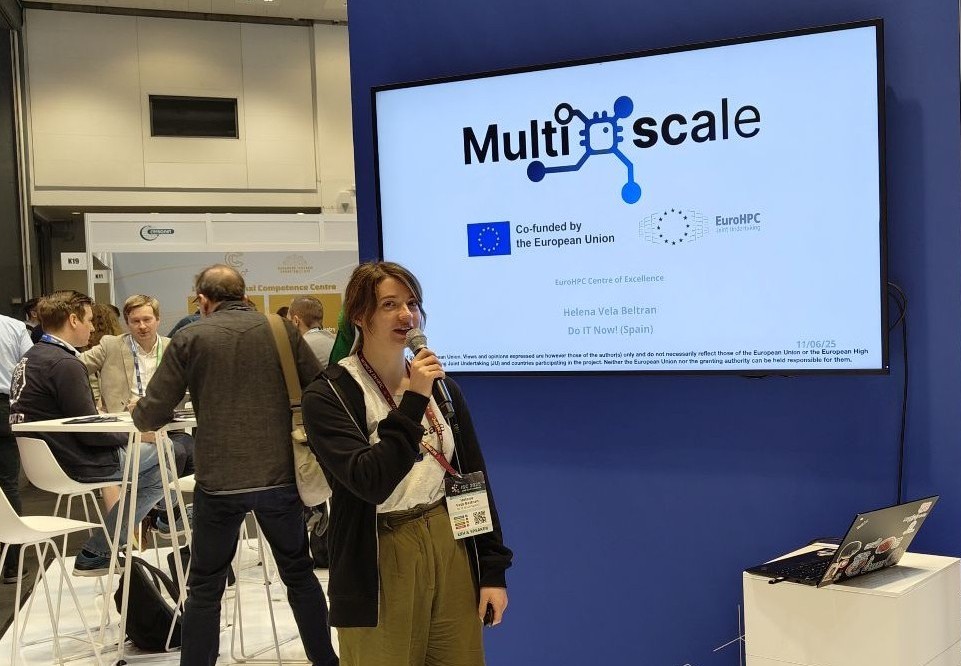
Join our MultiXscale experts in the following sessions at ISC25 Hamburg Germany: “Supporting cutting edge development of LAMMPS with EESSI” by MultiXscale expert Helena Vela ⏱️ Friday 13 June📌 Hall X10 – 1st floor (Workshop) Abstract:The MultiXscale CoE is an exascale-oriented application co-design and delivery for multiscale simulations. It is a collaborative project between members of the CECAM network and the EESSI community that will allow domain scientists to take advantage of the computational resources offered by EuroHPC JU. In this presentation we are going to focus on one of the lighthouse codes within #MultiXScale, LAMMPS, which is used by a large number of computational scientists. We will discuss how the developers of new plugins for LAMMPS are testing on a wide range of systems with the help of the software.eessi.io and dev.eessi.io repositories.The dev.eessi.io repository allows developers to share pre-releases of their software so they can test it on systems where EESSI is available, this includes the EuroHPC systems Vega, Karolina and Deucalion. For example, on Vega, development codes of LAMMPS are already available for using and testing through dev.eessi.io. In this talk we will show all the CI infrastructure to provide pre-released versions of your software using the plugins under development in MultiXscale, with LAMMPS as an example. More information here: https://pop-coe.eu/news/events/readiness-of-hpc-extreme-scale-applications-2nd-edition#Vela ———————————————————————————————————————————————————————————————————————————————— Exhibition: MultiXscale will be present at the EuroHPC JU booth J30. Our HPC expert Helena Vela will give a presentation on 11 June, from 12h20 to 12h40 Further details here: https://eurohpc-ju.europa.eu/media-events/events/eurohpc-ju-isc-high-performance-2025-2025-06-10_en

MultiXscale at ISC25 Hamburg (Germany) 10-13 June Read More »

HPC Annual Meeting – HPCKP25 Barcelona 3-5 June

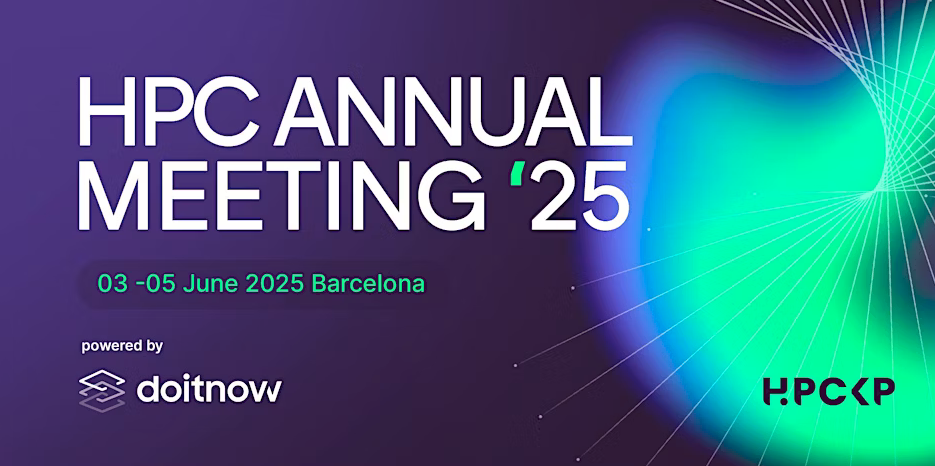
MultiXscale experts Alan O’Cais (University of Barcelona and CECAM) and Helena Vela (Do IT Now) will present “From zero to cloud (the EESSI way)” on 4 June at 9h10, during the HPC Annual Meeting – HPCKP25 Barcelona 3-5 June. Register here to watch the talk online!! Abstract: Discover how EESSI (European Environment for Scientific Software Installation) is transforming the way scientific software is deployed and shared across HPC systems, cloud platforms, and even laptops. In this session, we’ll introduce the motivation behind EESSI, its architecture, and how you can start using a fully pre-built, modular software environment — no matter where you compute. We will also demonstrate deployment to a cloud instance and cloud-based Slurm clusters!

HPC Annual Meeting – HPCKP25 Barcelona 3-5 June Read More »

SURF Research Day 2025, the national conference connecting research, IT, and innovation in Hilversum (Netherlands).

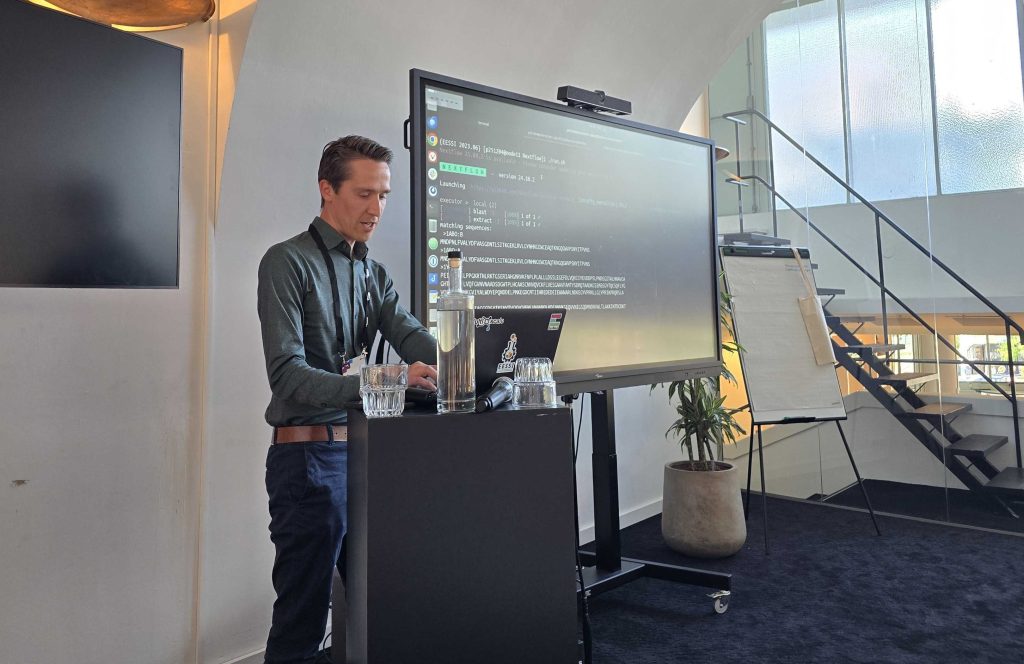
“The same software on any research infrastructure, wouldn’t that be EESSI?” by our MultiXscale expert Bob Dröge (University of Groningen) on 20 May, during the SURF Research Day 2025, the national conference connecting research, IT, and innovation in Hilversum (Netherlands). Abstract: Modern research often requires cloud or supercomputing infrastructure, but setting up your software environment on such systems can be challenging and time consuming. What if you could have the same software environment everywhere? The European Environment for Scientific Software installations (EESSI) provides a large, uniform stack of scientific software, ready to use on virtually any system in the world: from personal laptop, to a cloud VM, to the largest supercomputers in Europe. In this talk, you will learn how EESSI works, what possibilities it creates, and you will see it live in action. Installing scientific software on complex systems such as cloud VMs or a supercomputer can be a time-consuming hurdle, and may even discourage you from using the infrastructure that would – in theory – be most suitable for your work. It also means that, when you are set up on a system, you are unlikely to move anywhere else, even if better infrastructures become available. The European Environment for Scientific Software Installations (EESSI) is an open-source project that provides a large stack of scientific software, which can be easily made available on any system in the world. This allows you to start experimenting on a local laptop, and then seamlessly move to a cloud VM or supercomputer as your computational needs increase. Aside from alleviating the software installation burden, having the same software environment everywhere opens up many more unique opportunities. In this session we will show some examples, but also open the floor for informal discussion: which opportunities do you see? More info about the event: https://www.surf.nl/en/agenda/surf-research-day-2025

SURF Research Day 2025, the national conference connecting research, IT, and innovation in Hilversum (Netherlands). Read More »

Celebrating 10 years of Digital Humanities at KU Leuven!

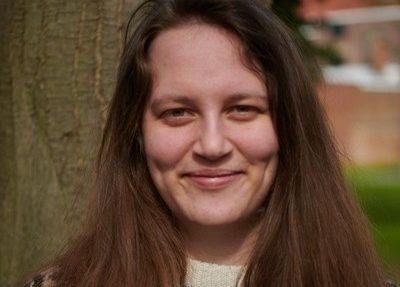
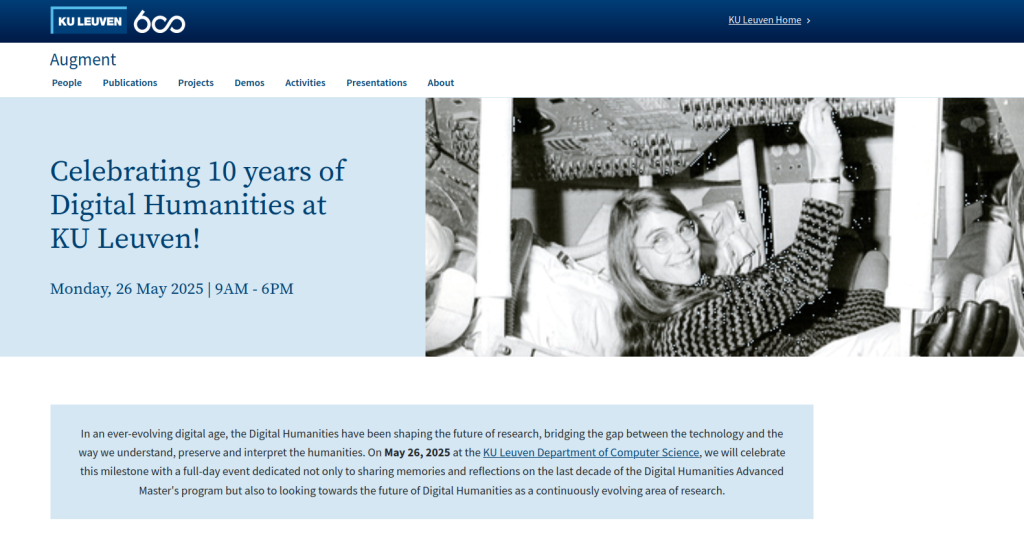
MultiXscale expert Lara Peeters (UGent) will participate in the “Panel 1: Pathways in Digital Humanities: insights and stories from DH Alumni”, from 15:30 to 17:00 on Monday, 26 May, and will present MultiXscale poster during the event Celebrating 10 years of Digital Humanities at KU Leuven! In an ever-evolving digital age, the Digital Humanities have been shaping the future of research, bridging the gap between the technology and the way we understand, preserve and interpret the humanities. On May 26, 2025 at the KU Leuven Department of Computer Science, we will celebrate this milestone with a full-day event dedicated not only to sharing memories and reflections on the last decade of the Digital Humanities Advanced Master’s program but also to looking towards the future of Digital Humanities as a continuously evolving area of research. More information here

Celebrating 10 years of Digital Humanities at KU Leuven! Read More »

Scroll to Top
Privacy Overview

This website uses cookies so that we can provide you with the best user experience possible. Cookie information is stored in your browser and performs functions such as recognising you when you return to our website and helping our team to understand which sections of the website you find most interesting and useful.