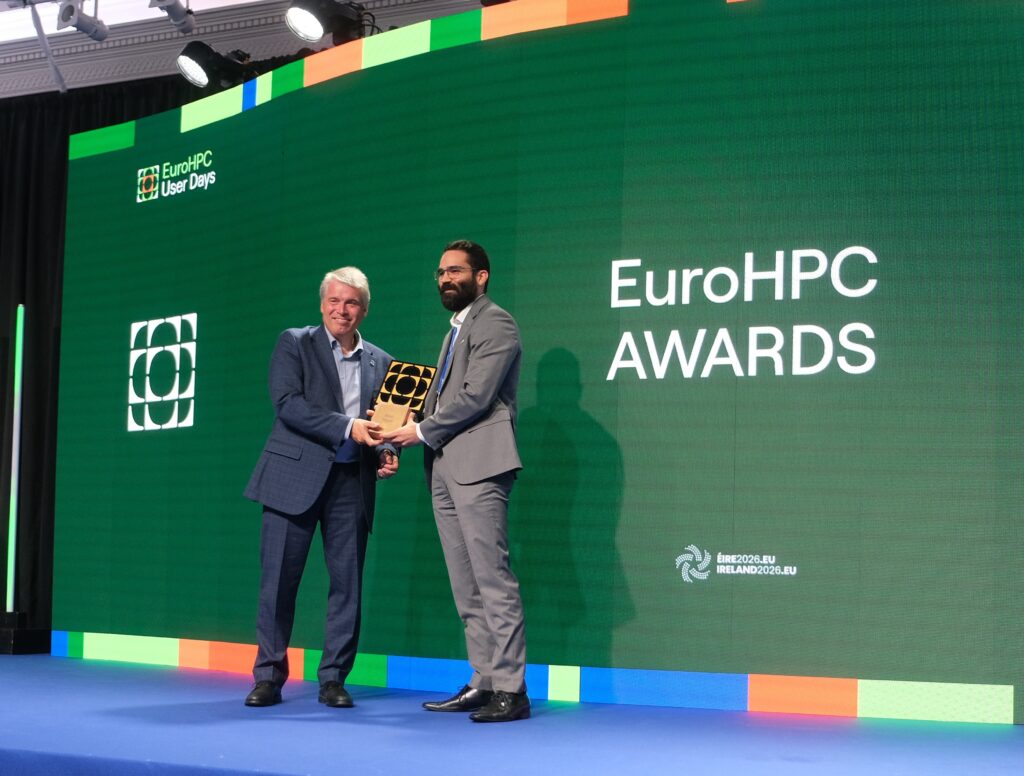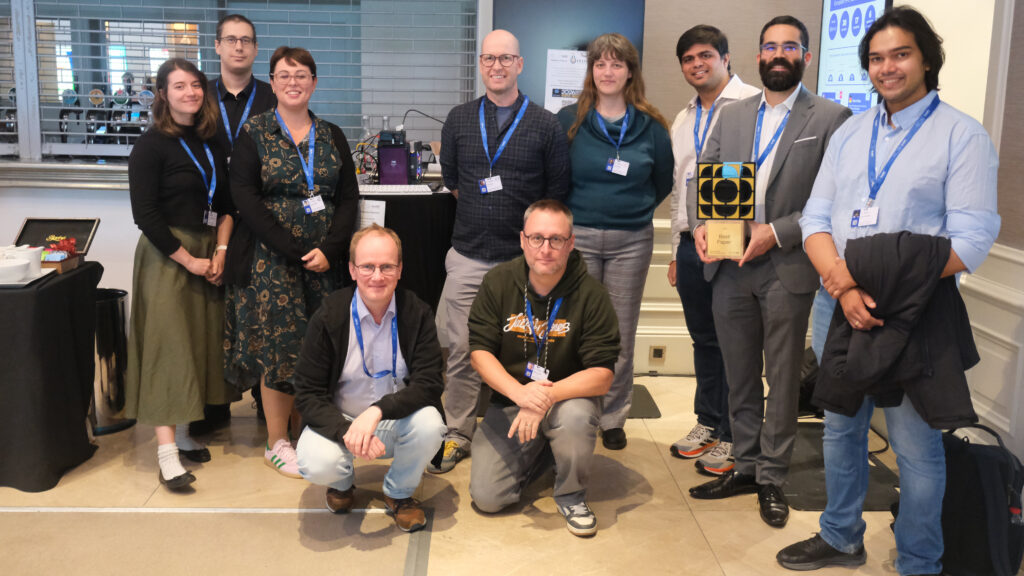
MultiXscale expert, Dr. Rodrigo Bartolomeu and members of MultiXscale CoE, have received one of the two Best Papers Awards at the EuroHPC User Days 2026 for: “Scaling and performance aspects of the P3M method on multiple GPUs”. This work was selected by the scientific review board for its clear and strong contribution to making complex scientific simulations run faster and more efficiently on modern supercomputers.
Abstract:
Long-range electrostatic interactions constitute a major computational bottleneck in particle-based simulations, particularly when periodic boundary conditions are employed. Mesh-based Ewald methods, such as the particle-particle particle-mesh (P3M) approach, reduce the computational complexity to O(N log N) but introduce challenges related to parallel scalability, communication overhead, and efficient utilization of modern heterogeneous architectures. While highly optimized implementations exist in established molecular dynamics packages, these are typically tightly coupled to full simulation frameworks, limiting their flexibility and reuse in emerging HPC applications.
In this work, we present a performance-portable library for electrostatic solvers, providing implementations of both classical Ewald and P3M methods targeting CPU and GPU architectures. The library is designed to enable efficient execution on multi-GPU systems while maintaining portability across heterogeneous platforms. We investigate scaling and performance characteristics of the P3M method, with particular focus on the FFT-based long-range component, which is known to limit scalability. Strong-scaling experiments demonstrate that small problem sizes are dominated by communication overhead, leading to reduced parallel efficiency, whereas larger systems achieve near-ideal scaling over a wide range of GPU counts.
Our results highlight the importance of balancing computation and communication in mesh-based electrostatics and demonstrate that portable, decoupled implementations can achieve competitive performance on modern HPC systems. The presented approach facilitates integration into diverse simulation workflows and provides a foundation for further optimization of long-range solvers in exascale computing environments.
More information available at EuroHPC JU website here