By Jean-Noël Grad
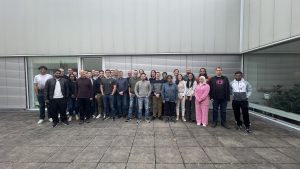
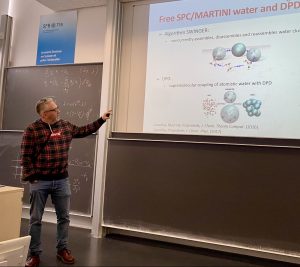
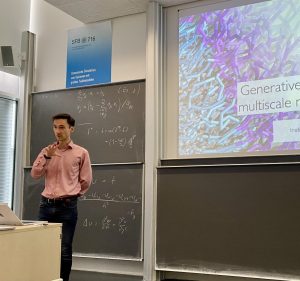
The ESPResSo summer school is a CECAM flagship school organized every year by the Institute for Computational Physics at the University of Stuttgart to train students and scientists in simulation software for soft matter physics and foster synergies between simulation experts and experimentalists. The 2024 edition focused on multiscale simulation methods. The event attracted 45 attendees and featured 14 talks and 11 posters. Lectures introduced the audience to particle-based simulations, long-range solvers for electrostatics, machine-learned inter-atomic potentials, coarse-graining techniques, and continuum methods, with a focus on the lattice-Boltzmann method. In hands-on sessions, participants learned to use ESPResSo, waLBerla, lbmpy and pystencils to model coarse-grained particle-based systems (noble gases, polymer diffusion, electrolytic capacitors), particle-fluid interactions at the mesoscale (sedimentation dynamics), and solvent-solute interaction at the continuum level (diffusion-advection-reaction methods). Field experts shared their experience in coarse-graining and machine-learning techniques to automatically transform atomistic descriptions of molecules into coarse-grained descriptions and vice-versa, improving sampling of the conformational space of disordered polymers, combining molecular dynamics and Monte Carlo algorithms to titrate polyelectrolytes, and studying protein and DNA motion at different levels of resolution using multiscale and multiphysics software.
The conference contributions have been collected into this book of abstracts. The talk slides can be obtained from the event website in the “Documents” tab, and recorded lectures are available on the YouTube channel ESPResSo Simulation Package.