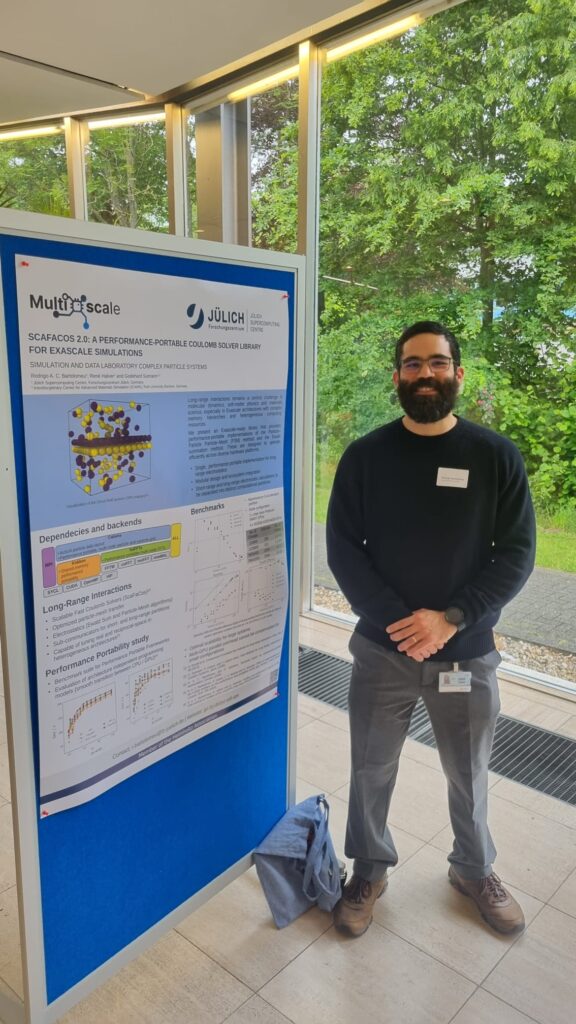
By Rodrigo Bartolomeu
At the Joint Laboratory for Extreme-Scale Computing (JLESC) workshop, which comprises members from INRIA, the University of Illinois, Argonne National Laboratory, the Barcelona Supercomputing Centre, the Jülich Supercomputing Centre and the RIKEN Center for Computational Science, our partners at Forschungszentrum Jülich presented the latest developments in the performance-portable electrostatics library, at JLESC 18th Workshop, from 19 to 21 May 2026.
The specialised audience of researchers and software developers shared common interests, focusing on performance tools, programming languages and advanced architectures.
Our poster presented a library ready for Exascale computing that implements the Particle–Particle–Particle–Mesh (P3M) and Ewald summation methods within a single source code base. Building on the Kokkos programming model enables the library to abstract away memory layout and execution details, allowing the same kernels to run efficiently on CPUs and GPUs from NVIDIA and AMD. It uses Cabana for cache-friendly particle data structures and HeFFTe for scalable, architecture-aware FFTs.
A key design principle is modularity: short- and long-range solvers are expressed as independent computational partitions. On systems that support heterogeneous partitioning, users can assign distinct resources to each partition to achieve better load balancing and overall throughput.
Preliminary benchmarks on the MareNostrum 5 GPU partition nodes demonstrate close to ideal strong scaling up to 128 GPUs for the long-range kernel, while maintaining numerical accuracy. These results demonstrate that a portable implementation can meet the performance demands of Exascale workloads without the need for multiple code bases.
Meaningful links:
1- https://www.fz-juelich.de/en/jsc/news/events/2026/18-jlesc-2026